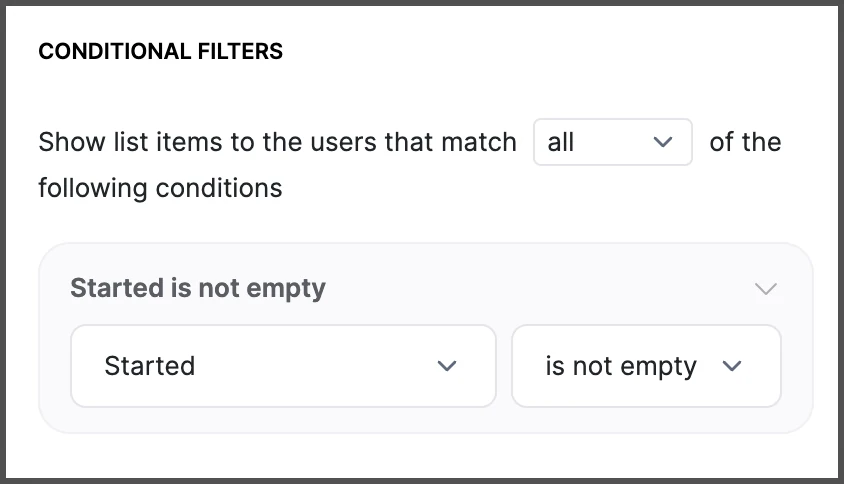
Conditional Filters
Setting up conditions to filter the list data.
Conditional filters show only the records that meet the conditions you define. They work on the List block and on other dynamic blocks.
In the Studio, this section is called Record filters. Find it in the Source tab of the block settings. See also Record filters.
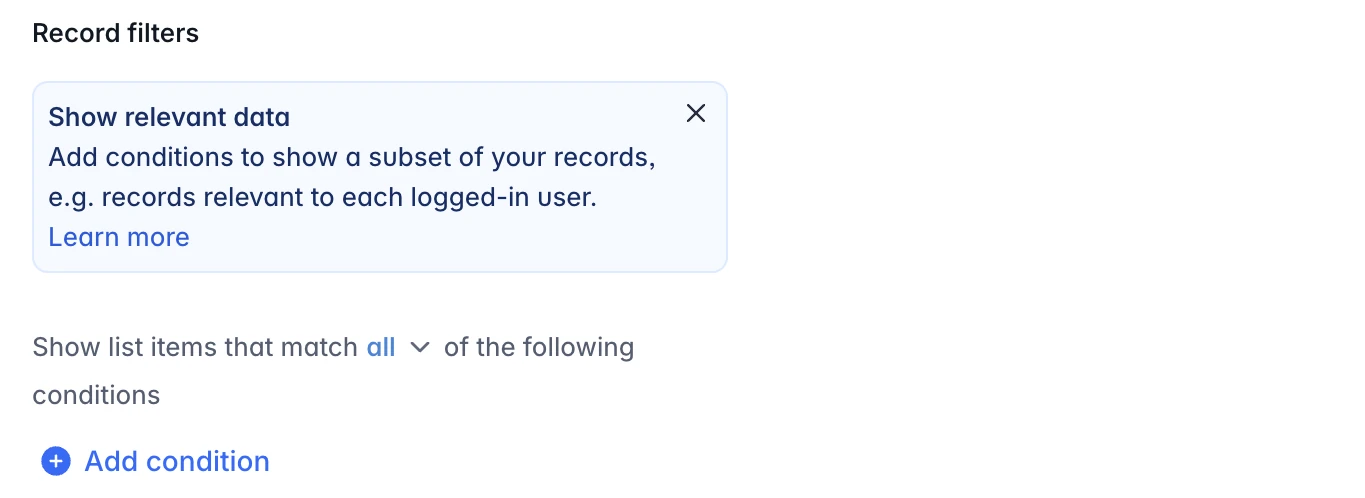
First, use the dropdown at the top to choose whether any or all of the conditions must be met.
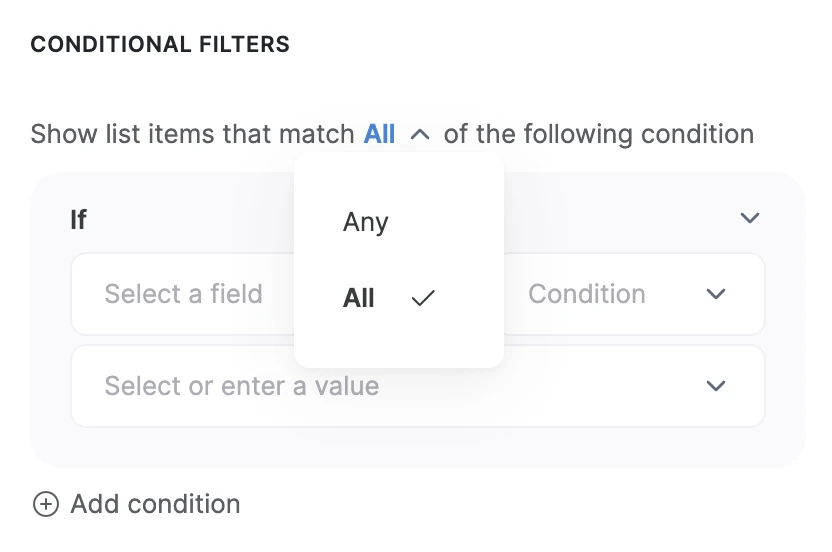
Extra conditions join with:
-
AND (when “All” is selected)
-
OR (when “Any” is selected)
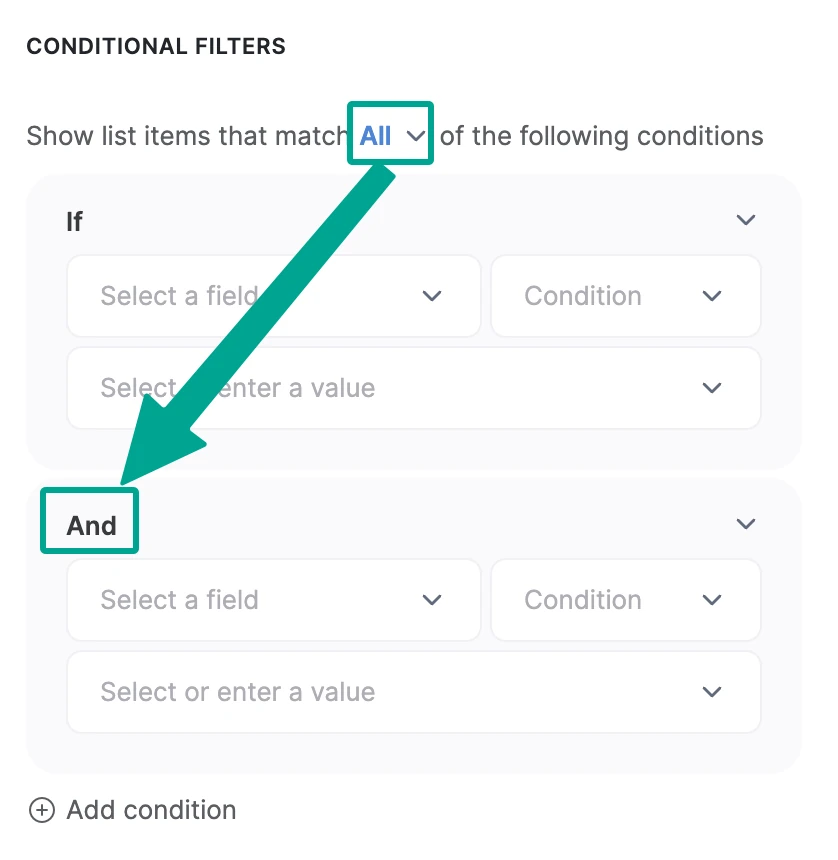
Each condition has three parts: a field, a condition, and a value.
1. Field
Select the field of the data source table that the condition tests.
2. Condition
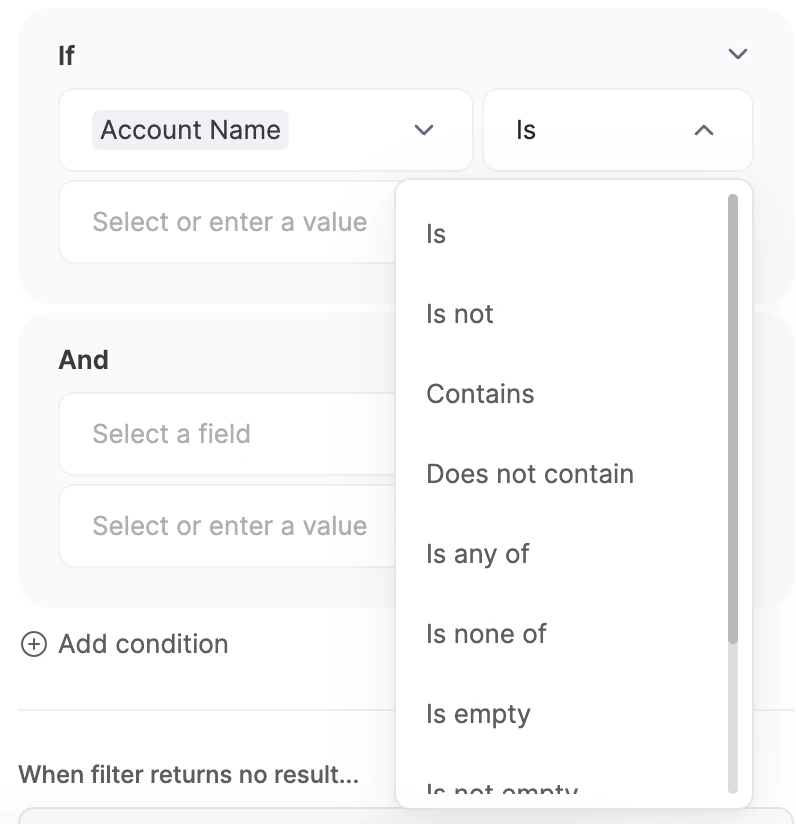
The condition describes how the field relates to the value. The available conditions depend on the field type.
Text-like fields, such as emails, formulas, URLs, and single select fields, can be used with the following available conditions:
-
Is – the Field value needs to match the Valueexactly
-
Is not – the Field value has any value apart from the Value
-
Contains – the Field value partially matches the Value
-
Does not contain - the Field value doesn’t partially match the Value. It checks if the given Value is not present within the Field value
-
Is any of –the Field value is any of the Value(s). Multiple values can be added
-
Is none of – the Field values have any other value apart from the Value(s). Multiple values can be added
-
Is empty – the Field value is empty
-
Is not empty – the Field value is not empty. Has some value
-
Starts with – the Field value starts with the Value
-
Ends with – the Field value ends with the Value
Numeric fields can be used with the following available conditions:
-
=
-
≠
-
>
-
<
-
≥
-
≤
-
Is between (inclusive of min/max)
-
Is empty
-
Is not empty
Array-like fields, such as multi-select fields, linked records, tags, and lookup fields, can be used with the following available conditions:
-
Includes any of
-
Includes all of
-
Includes exactly
-
Includes none of
-
Is empty
-
Is not empty
Boolean fields, such as checkbox fields:
-
Is
-
Is not
-
Is empty
-
Is not empty
3. Value
You have two options.
Entering a specific value
Enter a value. The block then shows only the records that have that value.
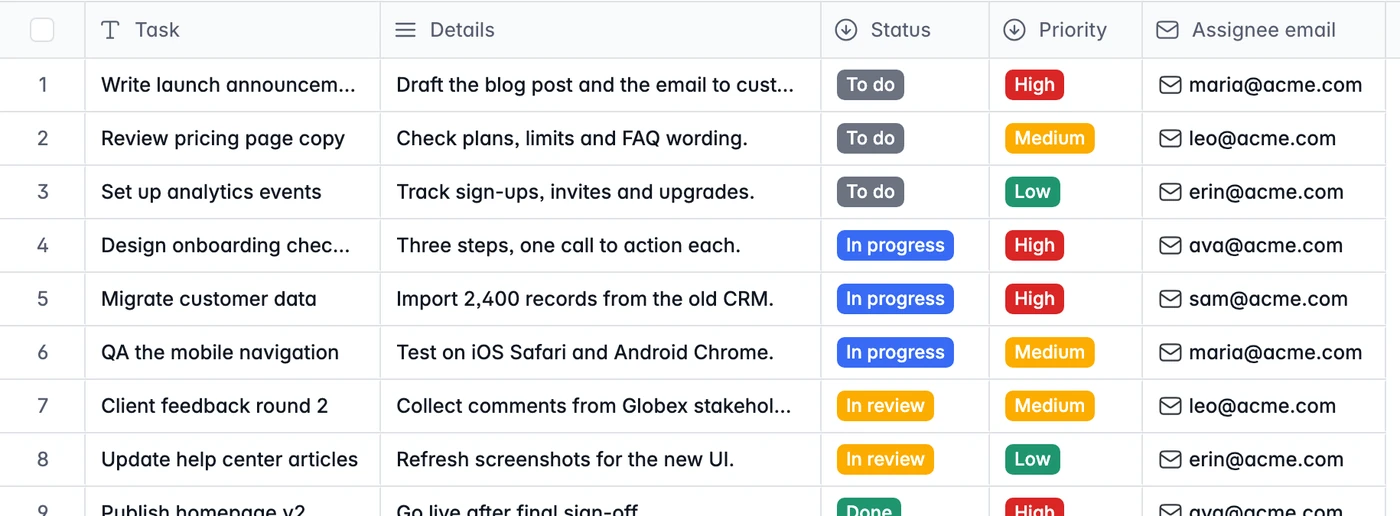
For example, a Tasks table in Softr Databases has a Status field. To show only the tasks in progress, set the condition to Status is In progress.
Using Logged-in user’s parameters
Use this option to filter the block for each logged-in user, so that each user sees only their own records.
By default, you can use the user’s Email and Email domain. If you’ve connected users to a data source, all the fields of that data source are available too.
Here is an example. The Tasks table has the fields Task, Status, and Assignee email. The Assignee email field holds the email of the user who owns the task.
Each user should see only their tasks. One condition does this. Set the Field to Assignee email and the value to the logged-in user’s Email. The block then shows only the tasks where Assignee email matches the email of the user who is logged in.

You can set a condition like this for any field of your block.
Use Case: Using a Checkbox field in a Conditional Filter
You can filter on a Checkbox field.
To show the records with the checkbox checked, use the is not empty condition. To show the unchecked records, use is empty.