CommunityHire an ExpertSign Up
Other Dynamic BlocksKanban
Other Dynamic Blocks

Kanban

Display data as a Kanban board.

A Kanban board with four columns: To do, In progress, In review, and Done

A Kanban board of tasks in a Softr app.

The Kanban block shows records from a data source as cards in columns, like a Kanban board. Each column is one value of a field, such as a status.

This page uses a table in Softr Databases. Connecting the data source, inline filters, and search work like they do in the List block. So this page covers the settings that are specific to the Kanban block.

Prepare your data

To show how the block works, we’ll use a Tasks table in a Softr Databases database. It has five fields:

  • Task (Short Text)
  • Details (Long Text)
  • Status (Select) with the options To do, In progress, In review, and Done
  • Priority (Select) with the options High, Medium, and Low
  • Assignee email (Email)

The Tasks table in Softr Databases, with the fields Task, Details, Status, Priority, and Assignee email

The Tasks table in Softr Databases.

Learn more about the available field types.

Connect the block to your table

  1. Add a Kanban block to your page.
  2. Open the Source tab of the block settings.
  3. Select Softr Databases as the account.
  4. Select the database, then select the table.
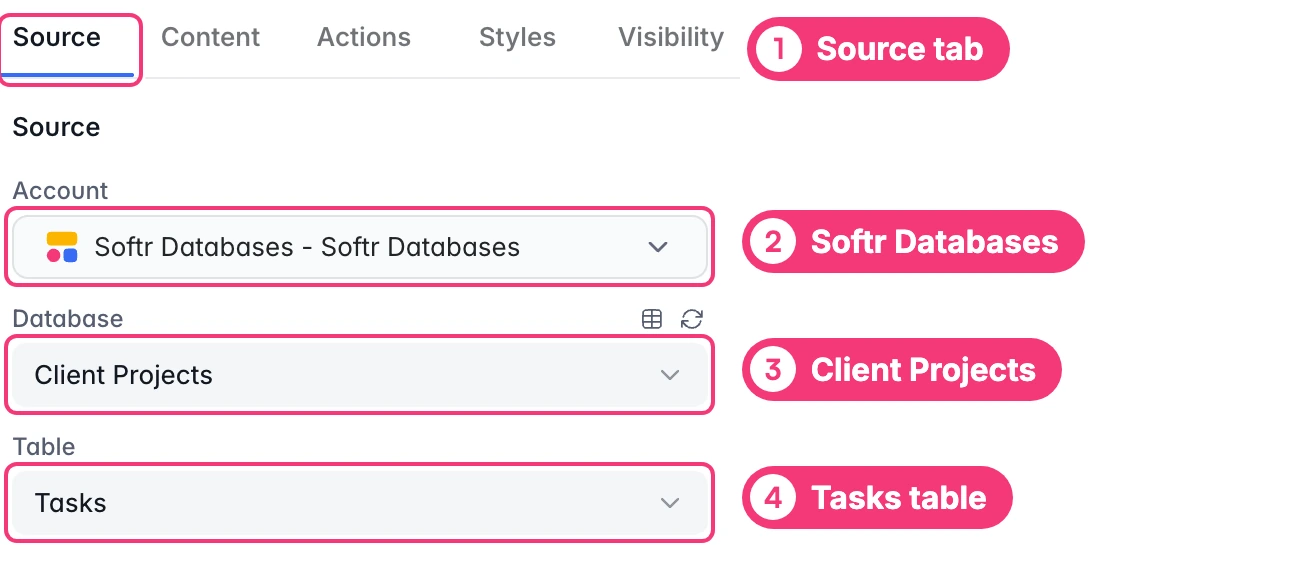
The Source tab of the Kanban block. Numbers point to the Source tab, the Softr Databases account, the database, and the table

The Source tab: the account, the database, and the table.

Group by

Open the Content tab. Under Group by, select the field that sets the columns. In our example, we select Status.

The board gets one column for each option of the field: To do, In progress, In review, and Done. Each card sits in the column that matches its value.
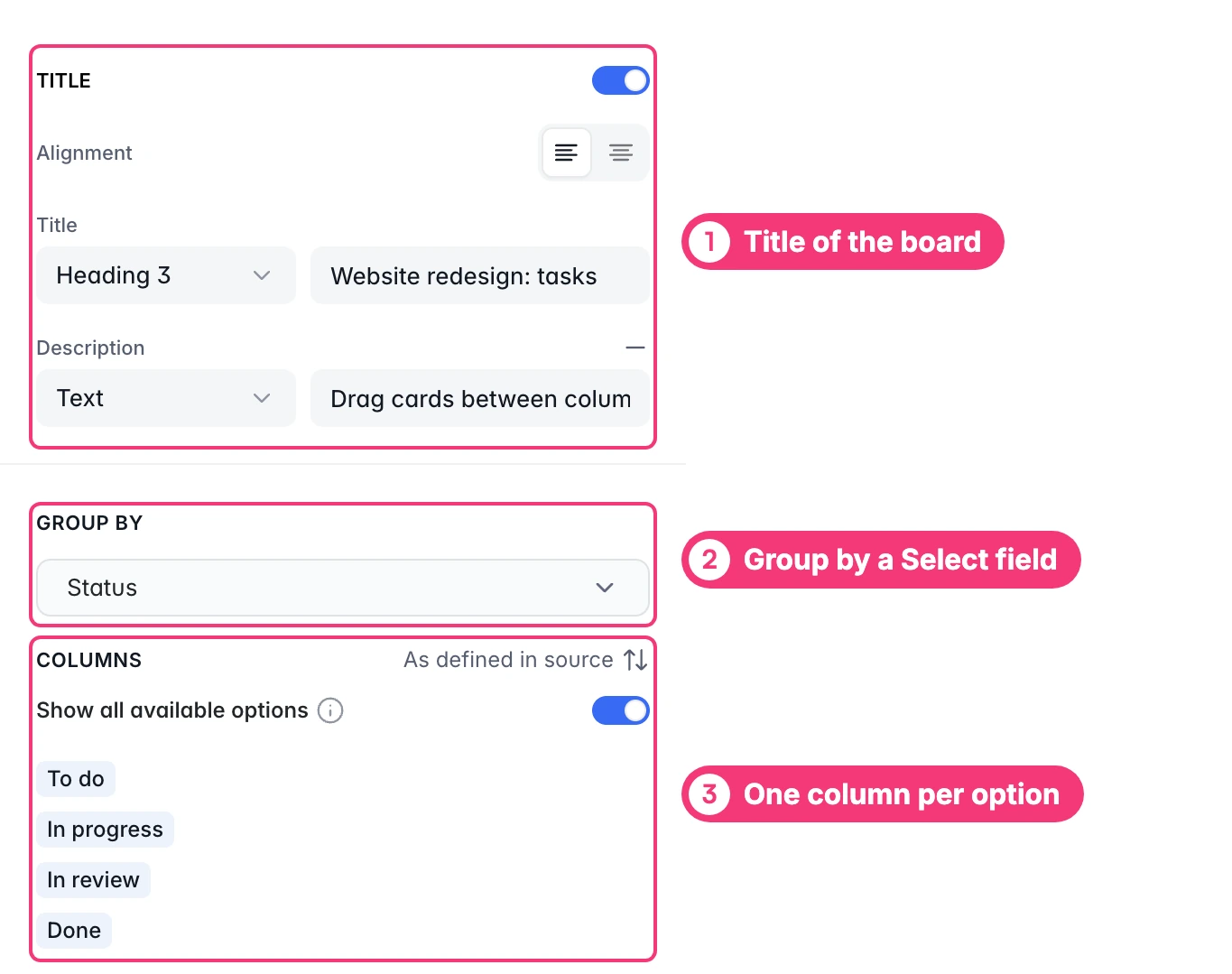
The Content tab of the Kanban block. Numbers point to the title, the Group by field, and the columns

The Content tab: the title of the board, Group by, and the columns.

By default, Show all available options is on, so every option of the field becomes a column. Turn it off to choose the columns yourself.

Choose what shows on each card

Under Item fields, map the fields that appear on the cards. In our example, Task is the heading, Details is the text, and Priority is a tag.

The footer shows two short fields side by side, such as a tag or a date.

Under Column options, choose the style of the board (Standard, Minimal, or Joined), the column width, and the height. You can also show the card count and hide overflowing columns.
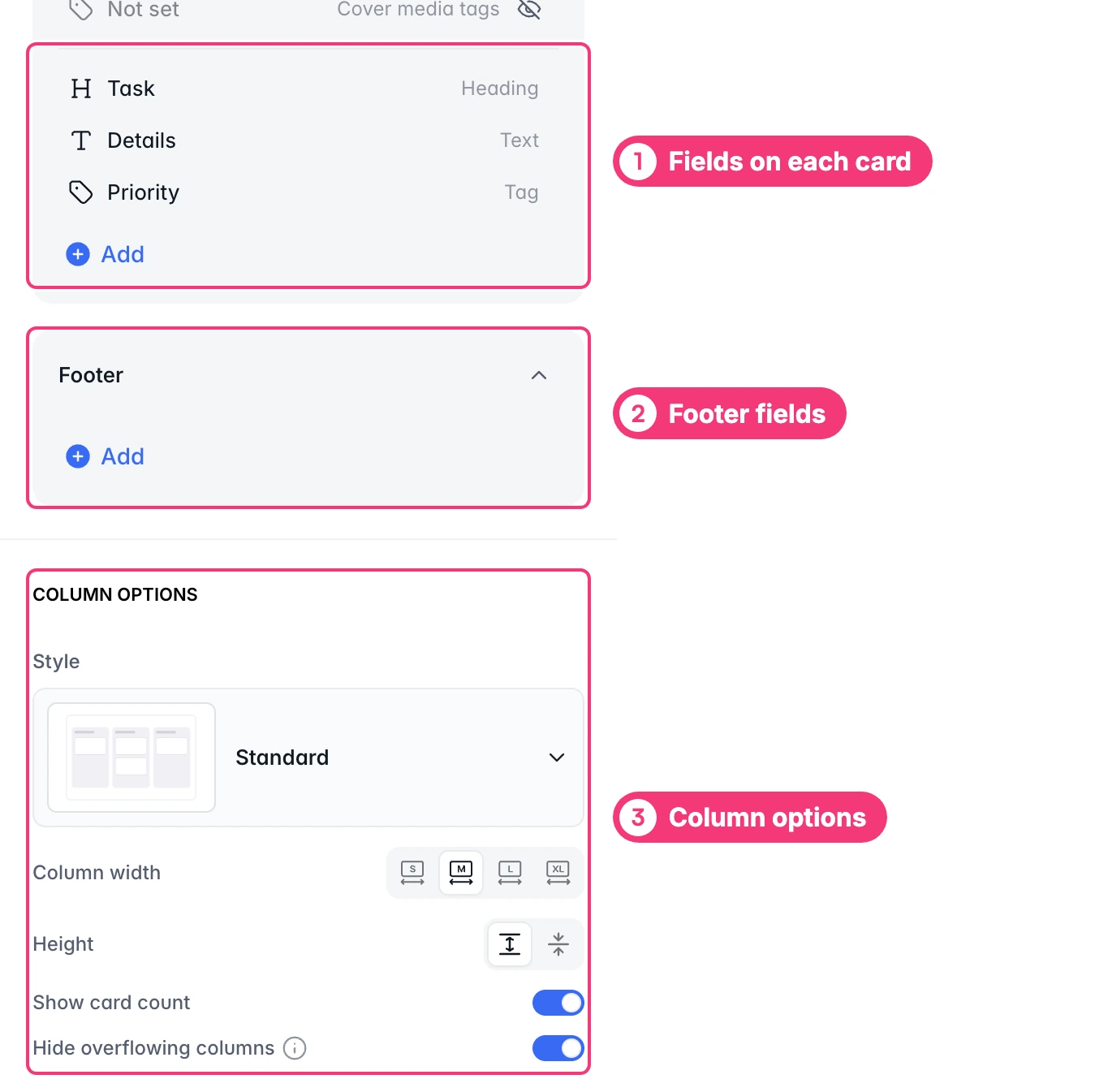
The Content tab of the Kanban block, further down. Numbers point to the item fields, the footer fields, and the column options

Item fields and column options.

Show each user only their tasks

Kanban’s conditional filters work like those of the List block. They are in the Source tab, under Record filters.

For our example, each logged-in user should see only their own tasks. To do that, add a condition: Assignee email is the logged-in user’s email.

  1. Under Record filters, click Add condition.
  2. Select the Assignee email field.
  3. Select Is.
  4. Select the logged-in user’s email as the value.
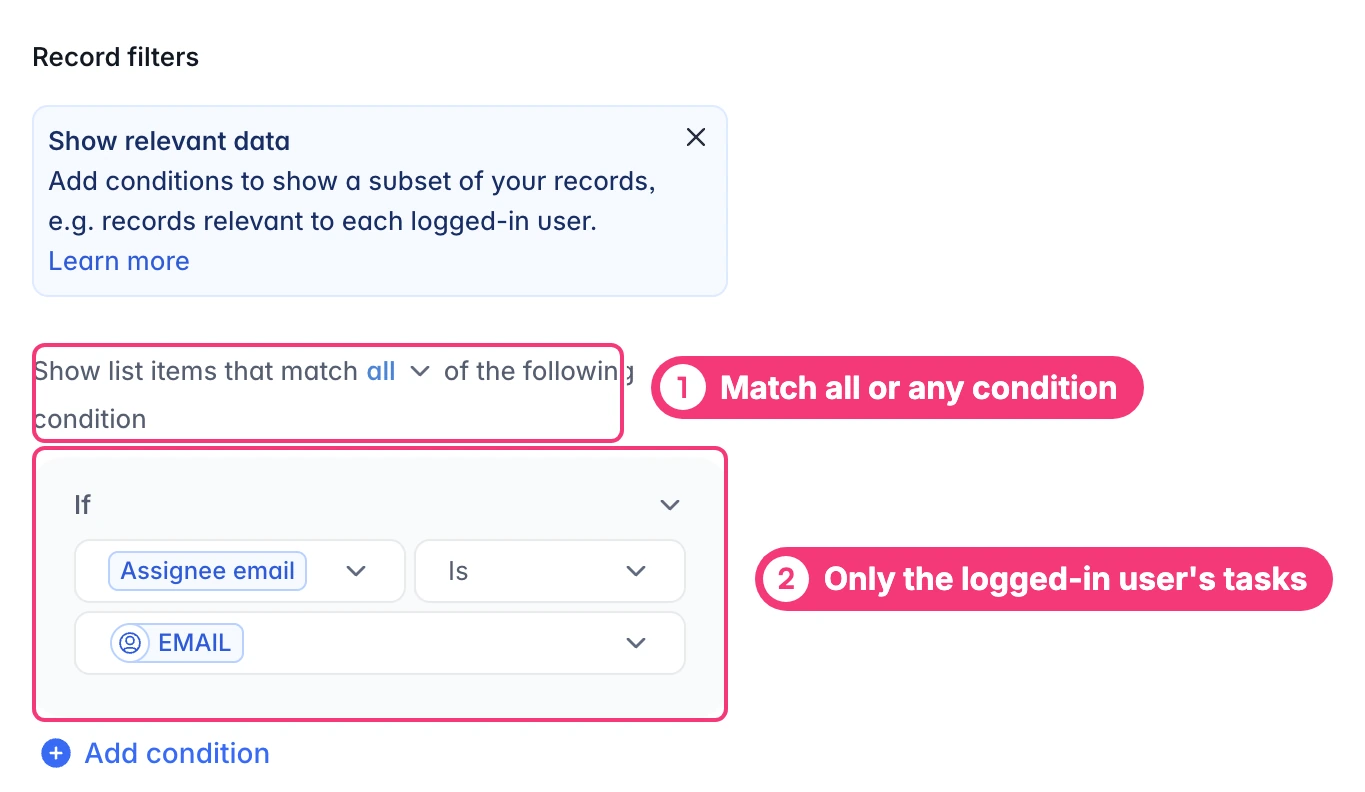
The Record filters section of the Kanban block. Numbers point to the match setting and to the condition on the Assignee email field

A record filter: Assignee email is the logged-in user's email.

Here is what maria@acme.com sees after logging in and opening the board.

A Kanban board that shows only the tasks assigned to one user

The board of one logged-in user.

Move cards between columns

If the Drag and drop toggle is on under Actions, logged-in users can drag cards between columns. You can also let only specific user groups move cards, through the visibility settings of the toggle.

A card in the middle of a drag from the In progress column to the In review column

Dragging a card from In progress to In review.

When a user moves a card to another column, the value of the card changes in the table too. In our example, we move Design onboarding checklist from In progress to In review. In Softr Databases, its Status changes to In review.


The Tasks table before the move. The Status of Design onboarding checklist is In progress

Before the move, the Status of the task is In progress.

The Tasks table after the move. The Status of Design onboarding checklist is In review

After the move, the Status of the task is In review.

Use these docs with your AI tools

An AI agent can read this documentation directly. You do not need an account or an API key. Everything here is public and read-only.

Query these docs via MCP

Recommended

Add this server to Claude, Claude Code, Cursor, Mistral, or any tool that supports MCP. Your agent can then search Softr Documentation documentation and read it in full, instead of answering from memory.

https://docs.softr.io/mcp
  • searchFind the passages that answer a question.
  • fetchRead one page in full, as Markdown.
  • list_pagesSee every page in this documentation.

Query these docs over HTTP

The same tools also work as plain web requests. Use this for scripts, or for any tool that does not support MCP. There is one endpoint per tool. Arguments go in the query string, and the answer comes back as JSON.

https://docs.softr.io/api/docs/search?query=custom+domain

Read the OpenAPI description. It is built from the same definitions as the tools, so it always matches what the endpoints do.

Read these docs as Markdown

Add .md to any page URL to get its Markdown source. You can also send the headerAccept: text/markdown to the page URL itself.

To read the whole documentation in one file, open llms-full.txt. For a short index of every page, open llms.txt.